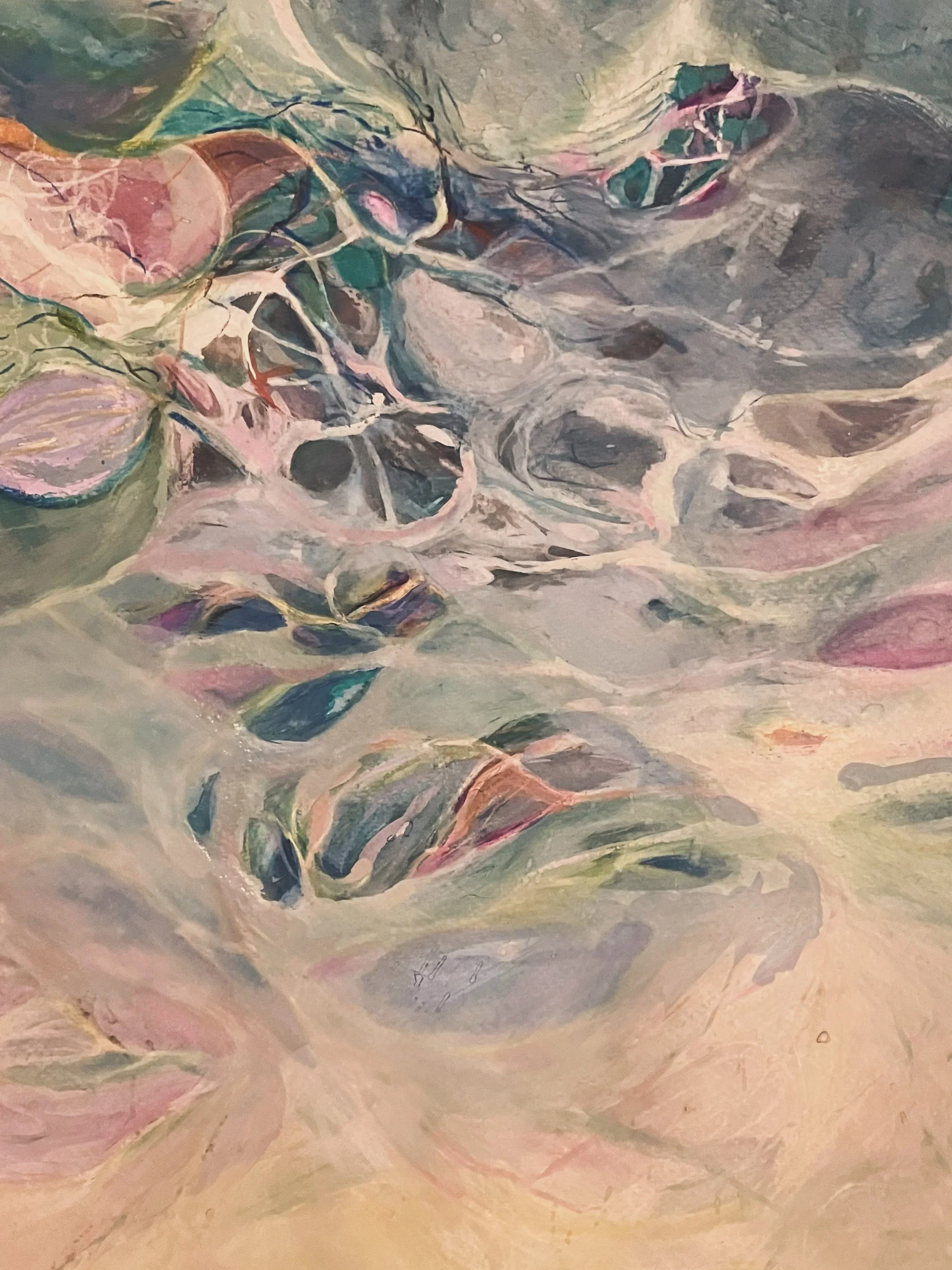
Studies of a Sirènx (2026, New York))
Watercolors bound with honey and gum arabic and gouache on cotton paper

Amniotic Suspension of a Marine Being II: Studies of a Sirènx serie II (2025, Hyères, France)
Botanical pigments — Mayan blue, and indigo watercolor pigments (dry and wet); ceramic bead; Sennelier French Ultramarine Blue and Cyan watercolors bound with honey and gum arabic; India ink and graphite on cotton paper
50 × 65 cm
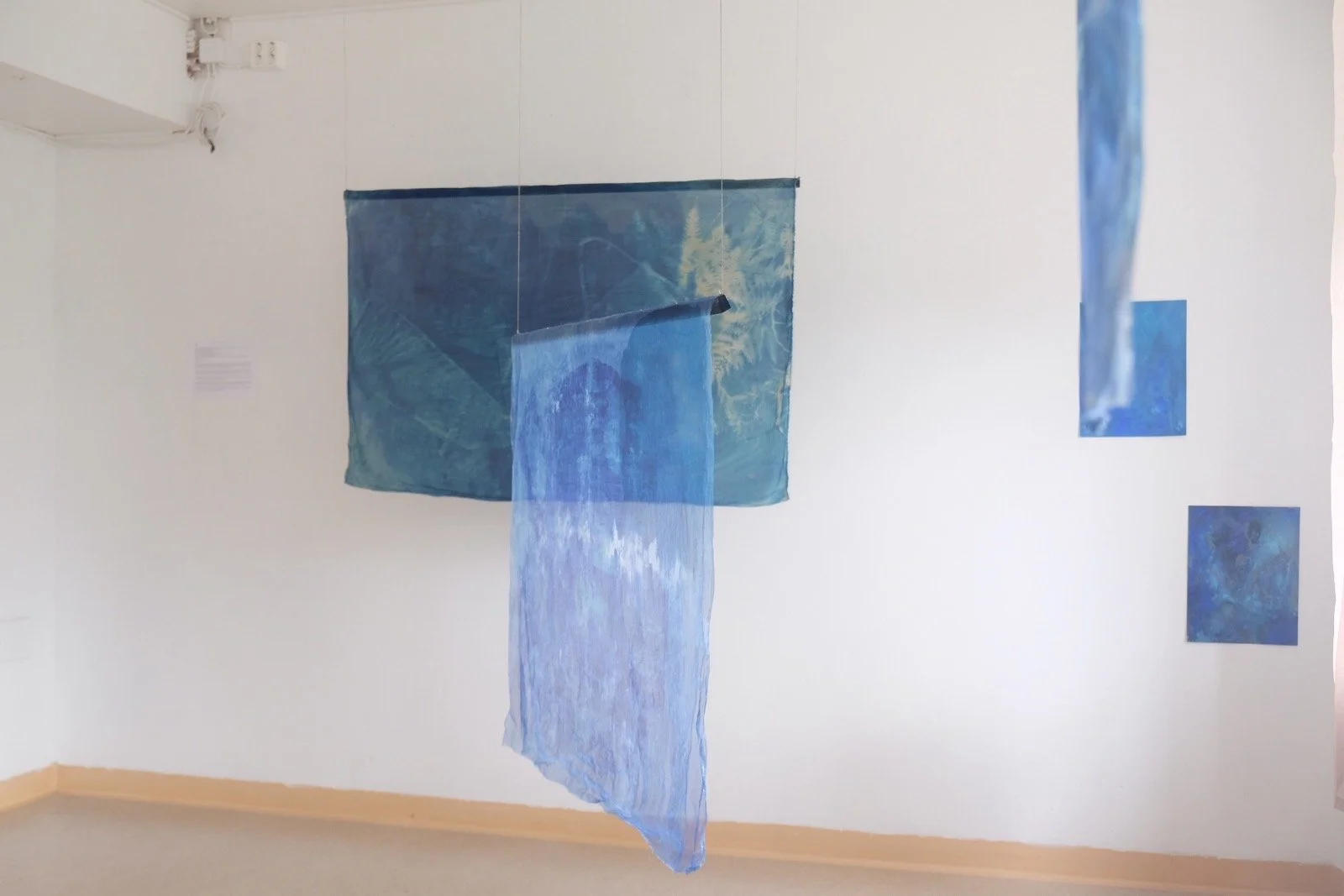
SIRÈNX (series), 2026, Finland
Sirènx has no genesis, fixed language, or gender. Here, the beautiful is also strange, shifting traditions of stillness. The artwork as a membrane: sirènxes. Toys become hosts of our manufactured humanity. Plants enter anatomy and become our teachers.
Sirènx is a partly unknowable hybrid, embryonic, native to the autonomous domain of artistic imagination, where freedom remains in a perpetual state of invention.
Media: Installation with cyanotypes on silk and organza; paintings on cotton paper with water-based pigments; collage and seed-oil-based pigment monotypes; sculptures made from cotton thread, wood, biopolymers, and stone; and fragments of sheer synthetic women’s tights incorporated into the sculptures.
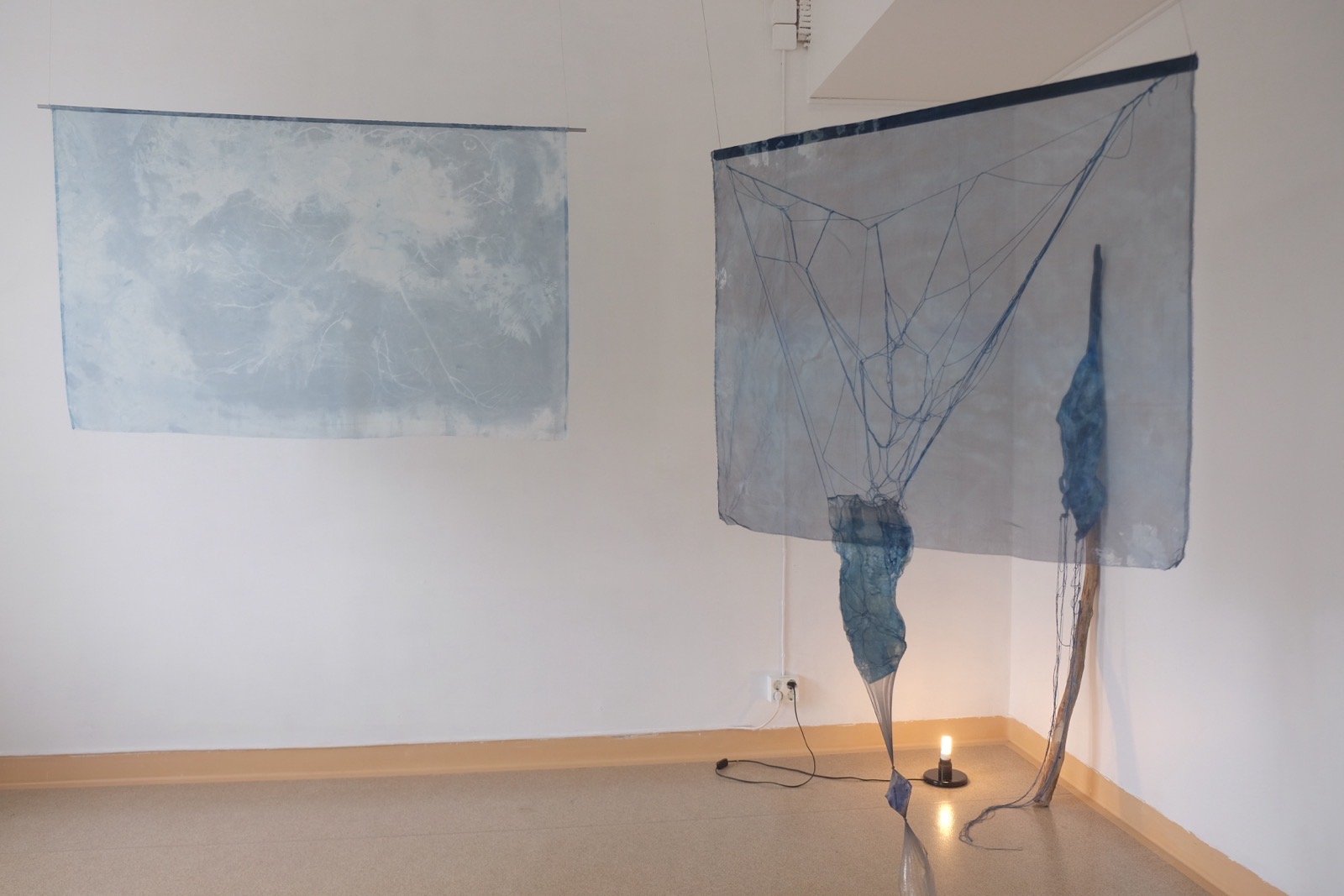
SIRÈNX (series), 2026, Finland
Sirènx has no genesis, fixed language, or gender. Here, the beautiful is also strange, shifting traditions of stillness. The artwork as a membrane: sirènxes. Toys become hosts of our manufactured humanity. Plants enter anatomy and become our teachers.
Sirènx is a partly unknowable hybrid, embryonic, native to the autonomous domain of artistic imagination, where freedom remains in a perpetual state of invention.
Media: Installation with cyanotypes on silk and organza; paintings on cotton paper with water-based pigments; collage and seed-oil-based pigment monotypes; sculptures made from cotton thread, wood, biopolymers, and stone; and fragments of sheer synthetic women’s tights incorporated into the sculptures.
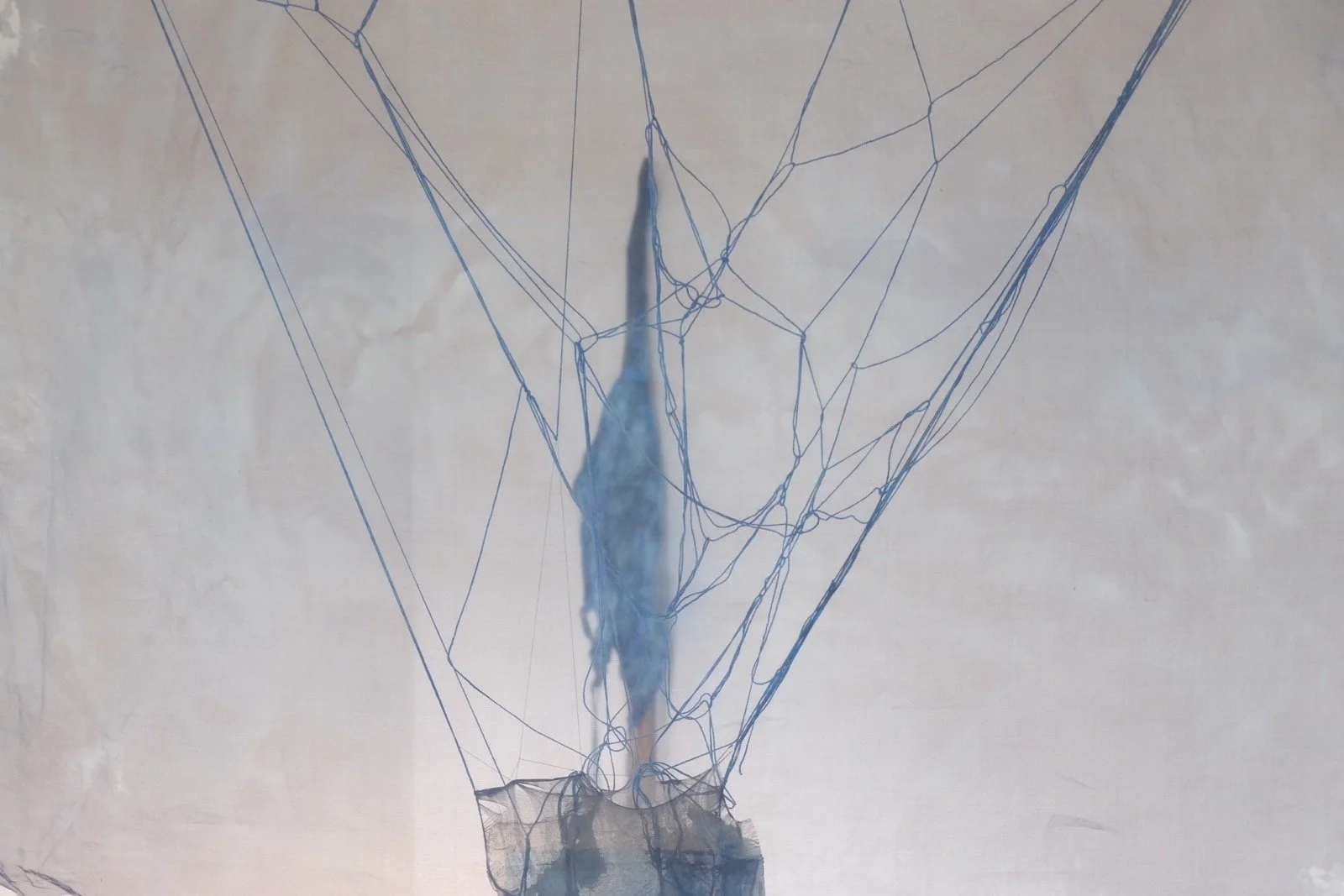
SIRÈNX (series), 2026, Finland
Sirènx has no genesis, fixed language, or gender. Here, the beautiful is also strange, shifting traditions of stillness. The artwork as a membrane: sirènxes. Toys become hosts of our manufactured humanity. Plants enter anatomy and become our teachers.
Sirènx is a partly unknowable hybrid, embryonic, native to the autonomous domain of artistic imagination, where freedom remains in a perpetual state of invention.
Media: Installation with cyanotypes on silk and organza; paintings on cotton paper with water-based pigments; collage and seed-oil-based pigment monotypes; sculptures made from cotton thread, wood, biopolymers, and stone; and fragments of sheer synthetic women’s tights incorporated into the sculptures.
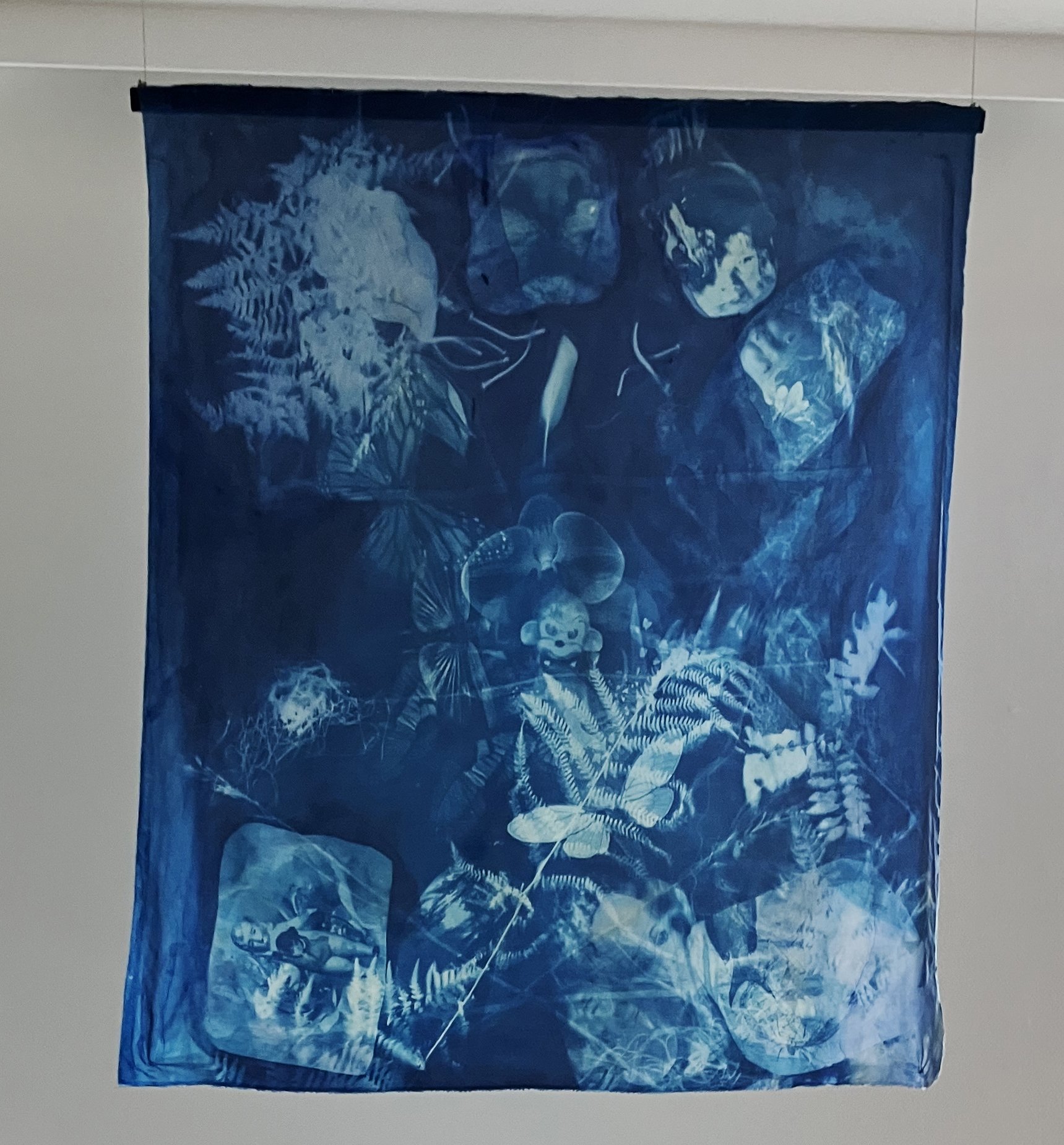
SIRÈNX (series), 2026, Finland
Sirènx has no genesis, fixed language, or gender. Here, the beautiful is also strange, shifting traditions of stillness. The artwork as a membrane: sirènxes. Toys become hosts of our manufactured humanity. Plants enter anatomy and become our teachers.
Sirènx is a partly unknowable hybrid, embryonic, native to the autonomous domain of artistic imagination, where freedom remains in a perpetual state of invention.
Media: Installation with cyanotypes on silk and organza; paintings on cotton paper with water-based pigments; collage and seed-oil-based pigment monotypes; sculptures made from cotton thread, wood, biopolymers, and stone; and fragments of sheer synthetic women’s tights incorporated into the sculptures.
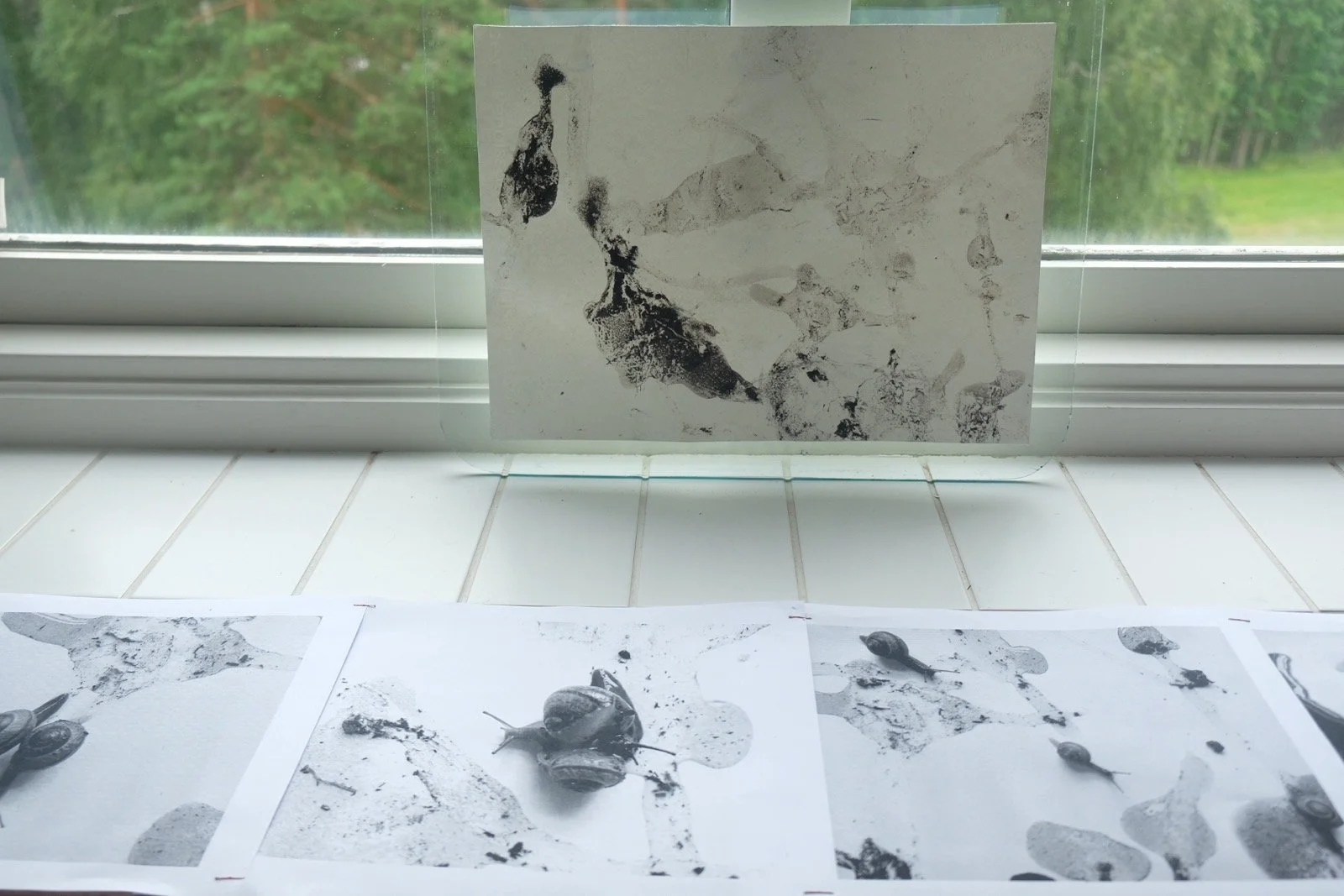
Untitled (SIRÈNX series), 2026
This work, made with living snails, extends the Sirènx series' exploration of how human, animal, plant, object, and spirit continuously invent one another. As the snails moved across cotton paper, they left traces that may be read as drawing, landscape, cartography, or calligraphy. Yet these are human interpretations. Whether the marks are simply movement or forms of communication, orientation, or memory belongs to worlds we cannot fully know. The work remains suspended between another species' existence and our persistent desire to translate it into human language, inviting drawing to emerge as an open interspecies question.
The snails remained within a habitat composed of soil, water, and charcoal gathered from the place where they were found. After exploring the paper, they were safely returned to their environment. During the process, they also engaged in courtship behavior, according to biological research.
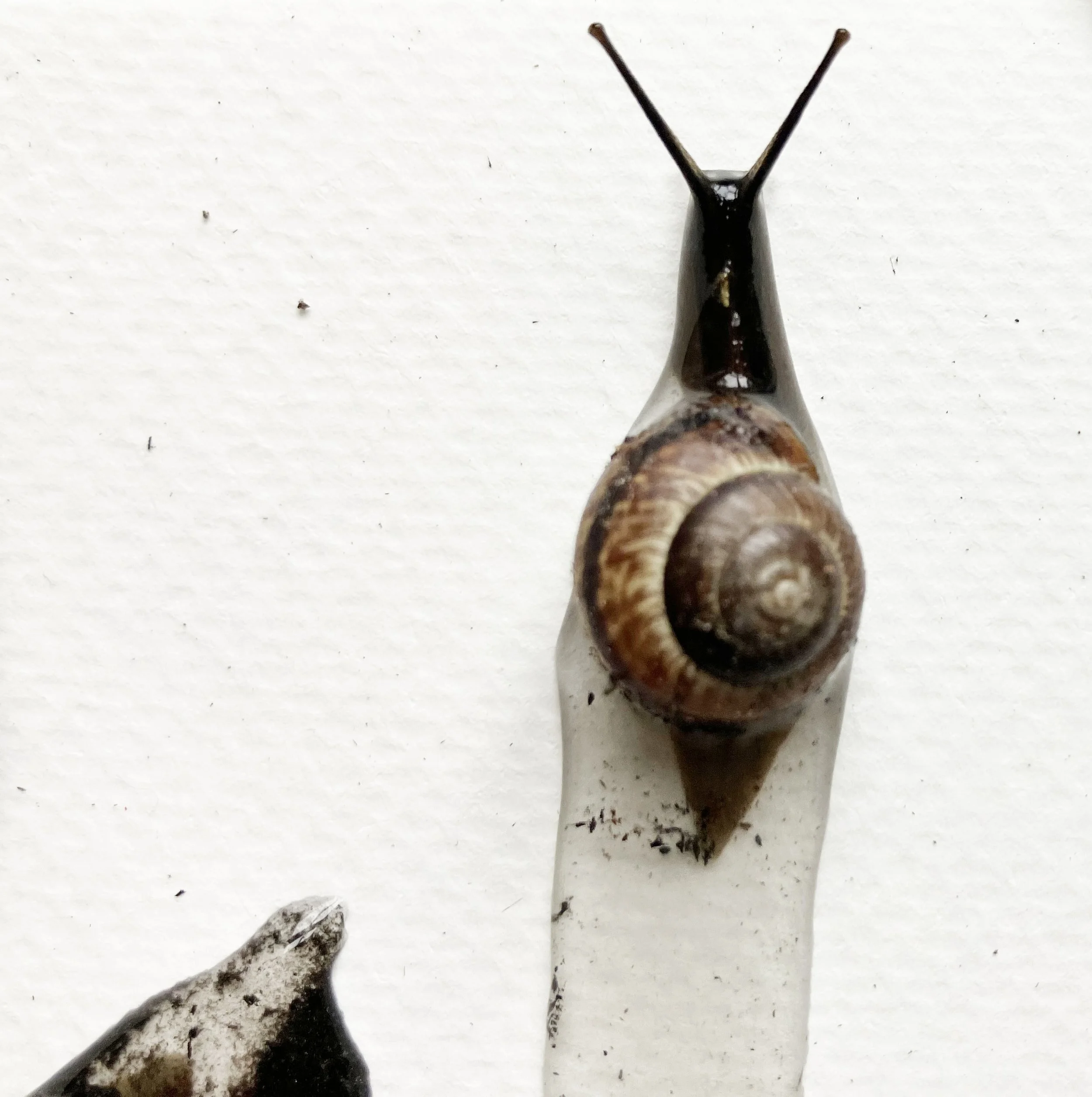
Untitled (SIRÈNX series), 2026
This work, made with living snails, extends the Sirènx series' exploration of how human, animal, plant, object, and spirit continuously invent one another. As the snails moved across cotton paper, they left traces that may be read as drawing, landscape, cartography, or calligraphy. Yet these are human interpretations. Whether the marks are simply movement or forms of communication, orientation, or memory belongs to worlds we cannot fully know. The work remains suspended between another species' existence and our persistent desire to translate it into human language, inviting drawing to emerge as an open interspecies question.
The snails remained within a habitat composed of soil, water, and charcoal gathered from the place where they were found. After exploring the paper, they were safely returned to their environment. During the process, they also engaged in courtship behavior, according to biological research.
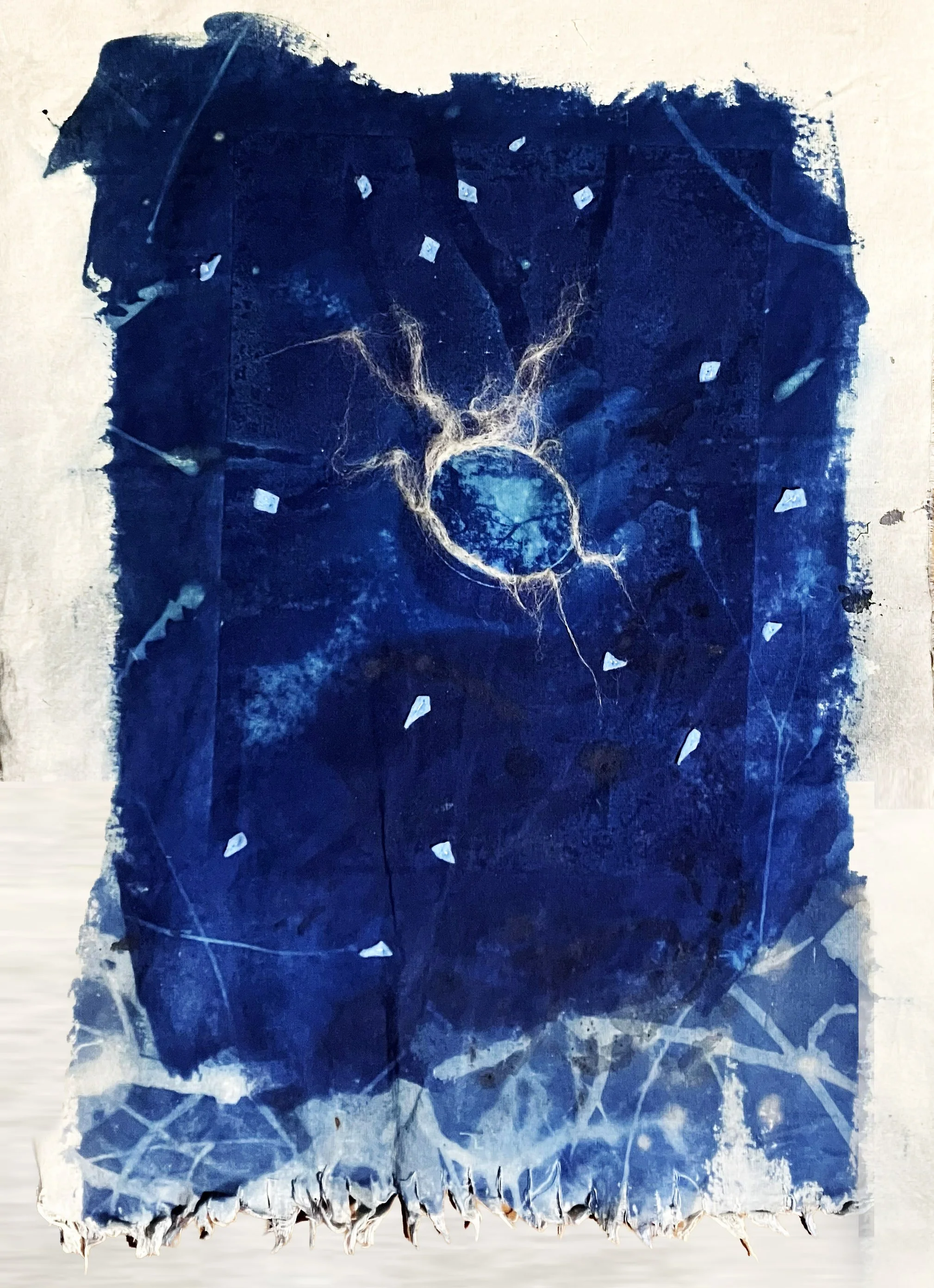
Mirrorment I, Searching for Diffracting, 2025, Argentina
Cyanotype on cotton fabric with natural sheep wool felt from Argentina
40 × 60 cm
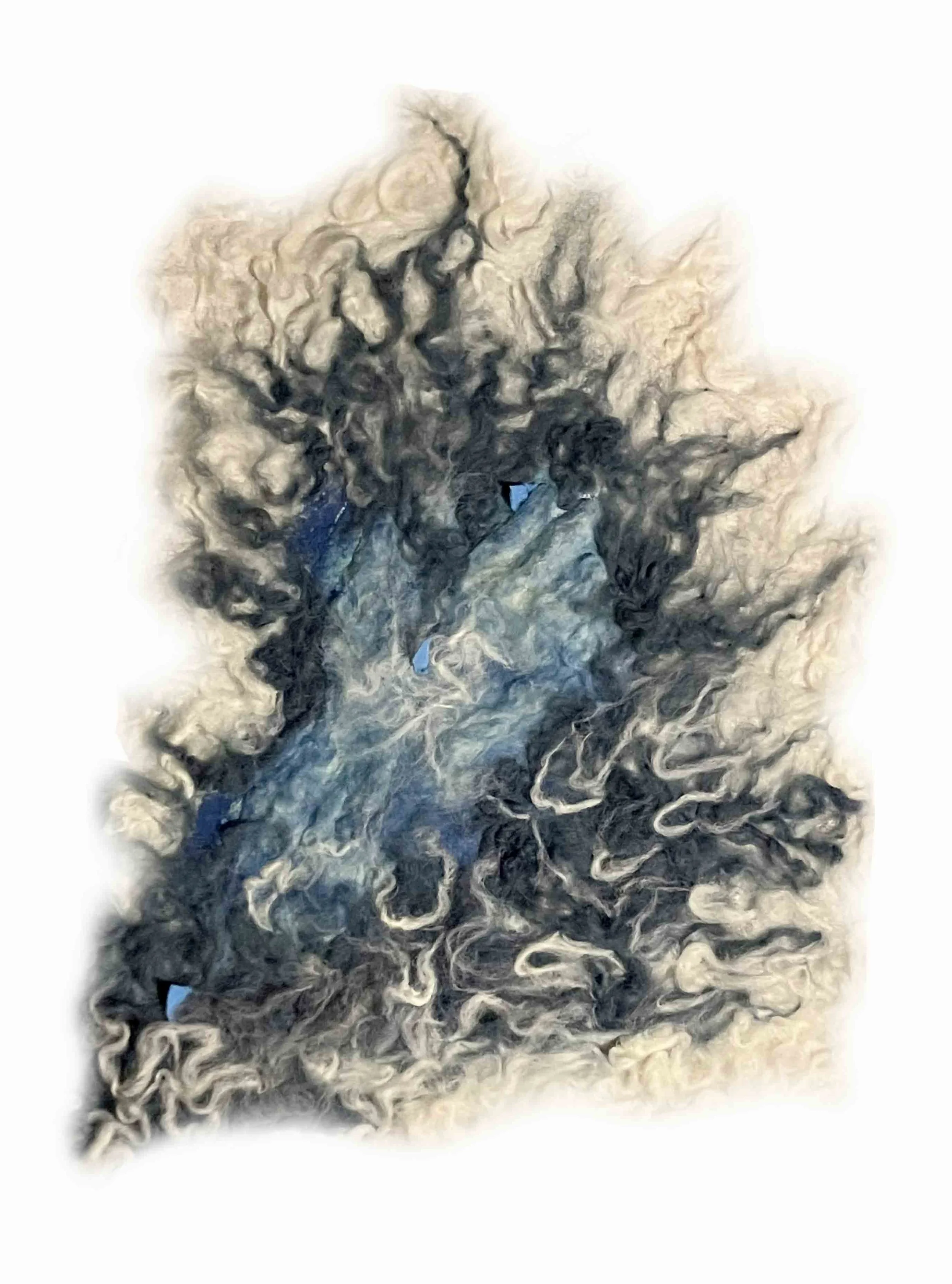
Vapor pulse (2025, Argentina)
Natural sheep wool felt on natural cotton fabric
35 × 65 cm
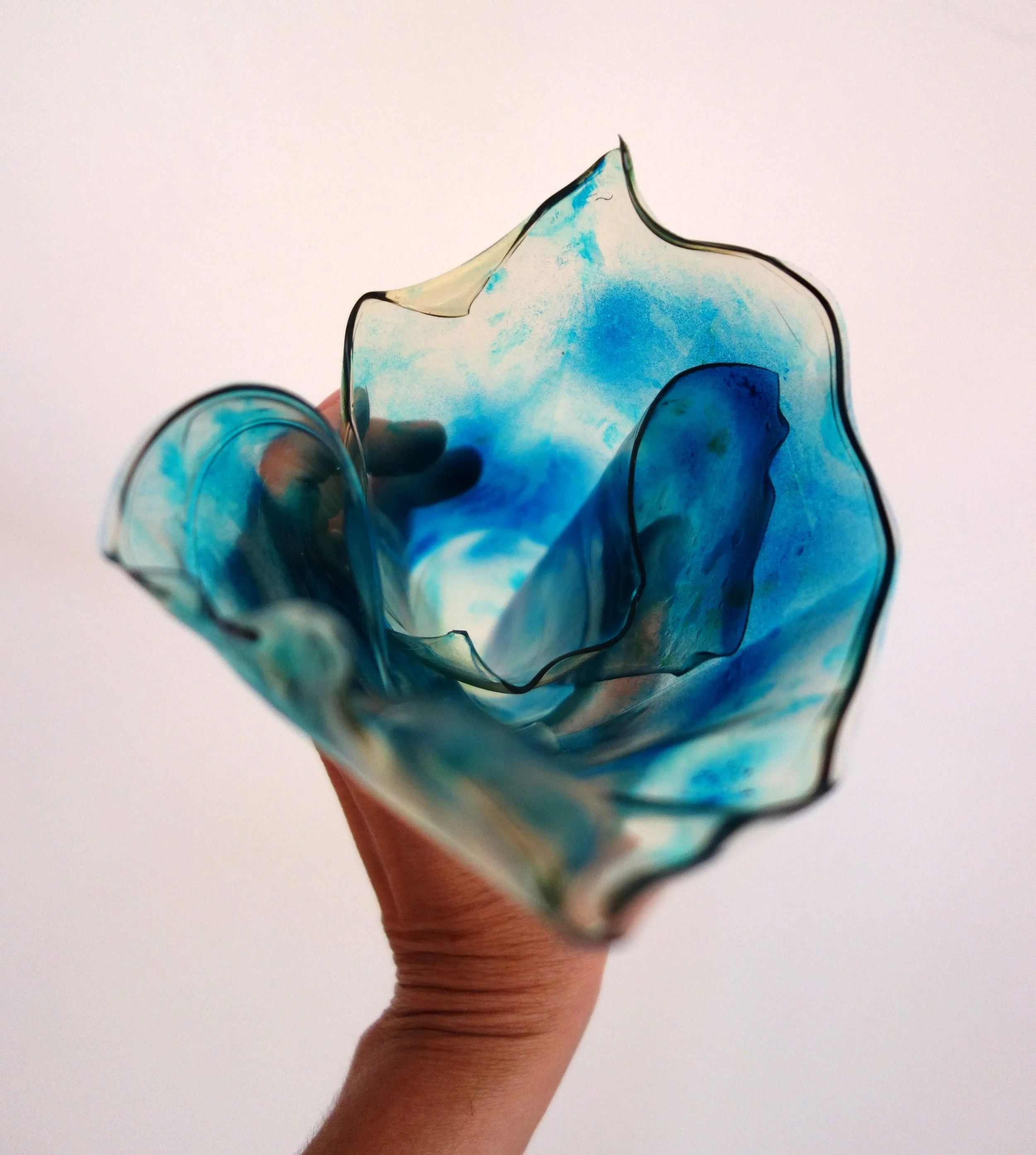
Translucent Organism (2024, Brooklyn, NY)
Materials: gelatin, glycerin, sodium propionate, and blue food pigment.
This biopolymer sculpture explores the fluid boundary between organic and synthetic matter. Created through a process of controlled heating, cooling, and spontaneous deformation, the material retains a fragile translucency that evokes marine membranes and vegetal tissues. As it dries, it bends and curls into unpredictable forms, embodying both growth and decay in a single gesture.
While I have long worked with fabrics, paper, water-based media, found objects, and technology, Translucent Organism marked a turning point in my practice: the beginning of my research into biomaterials as regenerative living archives, translating laboratory learning into a sensory meditation on ecological temporality, fragility, and care.
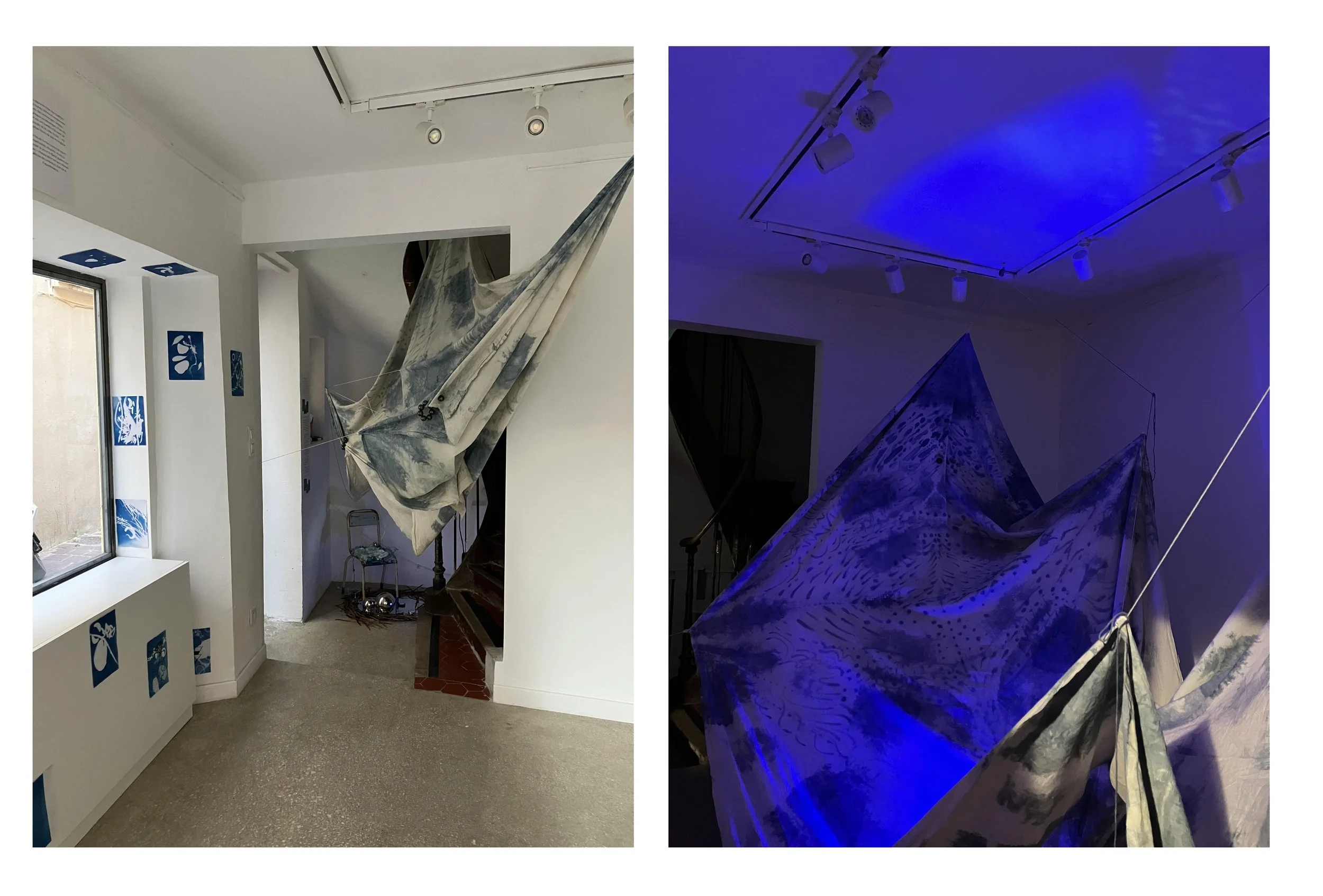

Fires of the Sun and the Earth (2025, Oaxaca, Mexico)
Medium: geomantic fresco mural created with Mayan and mineral pigments, integrating principles of solar geometry and geomancy. This mural was developed at the Oaxaca School of Muralism, guided by Mexican muralist Jesús González, and in collaboration with regenerative Guatemalan architect Rocío Araujo.

Amniotic Suspension of a Marine Being III: Studies of a Sirènx serie (2024, New York, USA)
Watercolor pigments (dry and wet); India ink, graphite on paper over wood frame

Matternauta (2025, Oaxaca, Mexico)
The lamp is woven from rice paper and vegetal fibers, dyed with cempasúchil, lime, and palo de Brasil, and features seashell pendants collected from the Oaxacan coast. The paper hat is tinted with beet tincture. The earth-painted textile beneath is cotton prepared with eucalyptus and painted with soil from the Mixteca region.
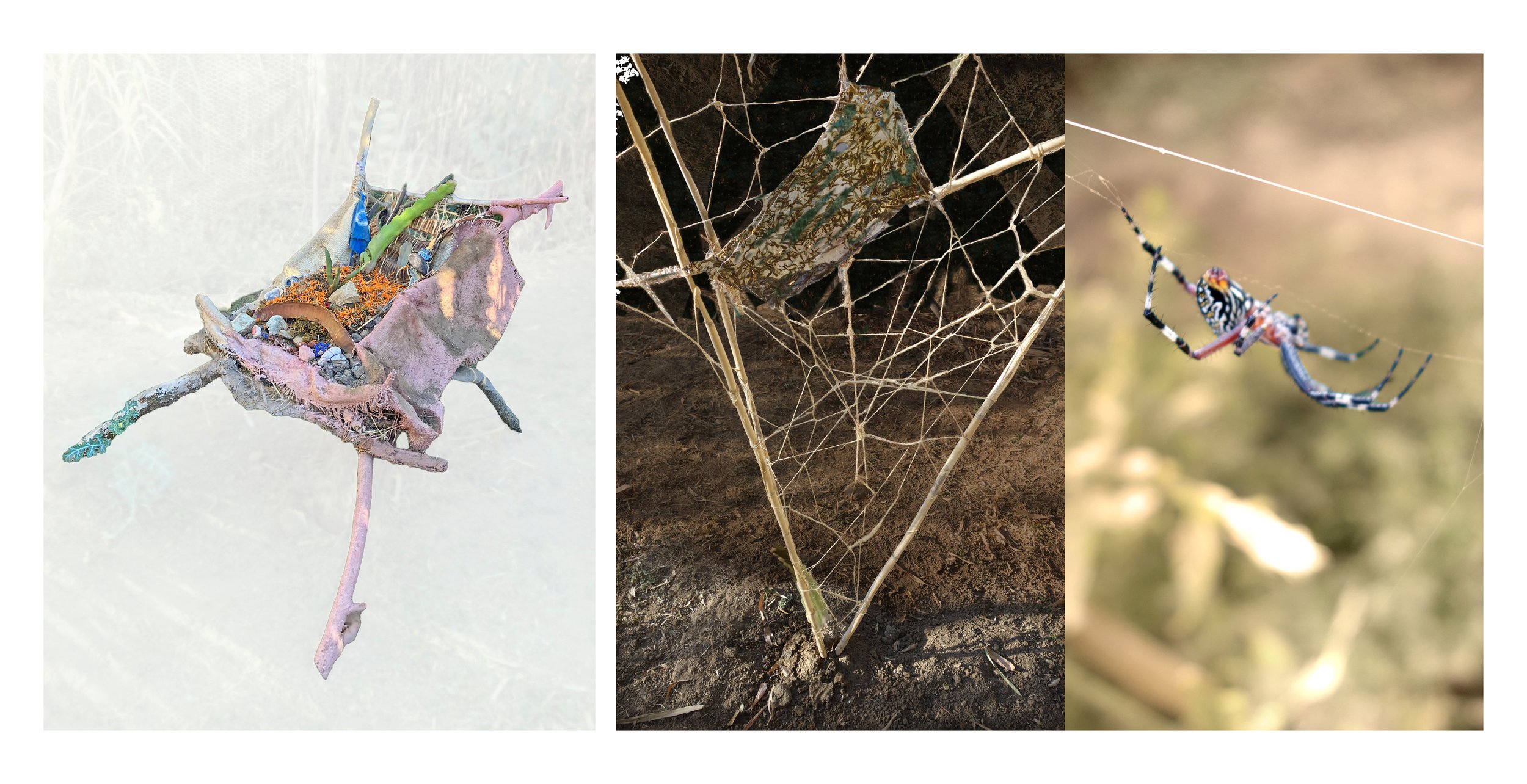
LivingChair and Sculpture for and with spiders (2024, Etla, Oaxaca, Mexico)
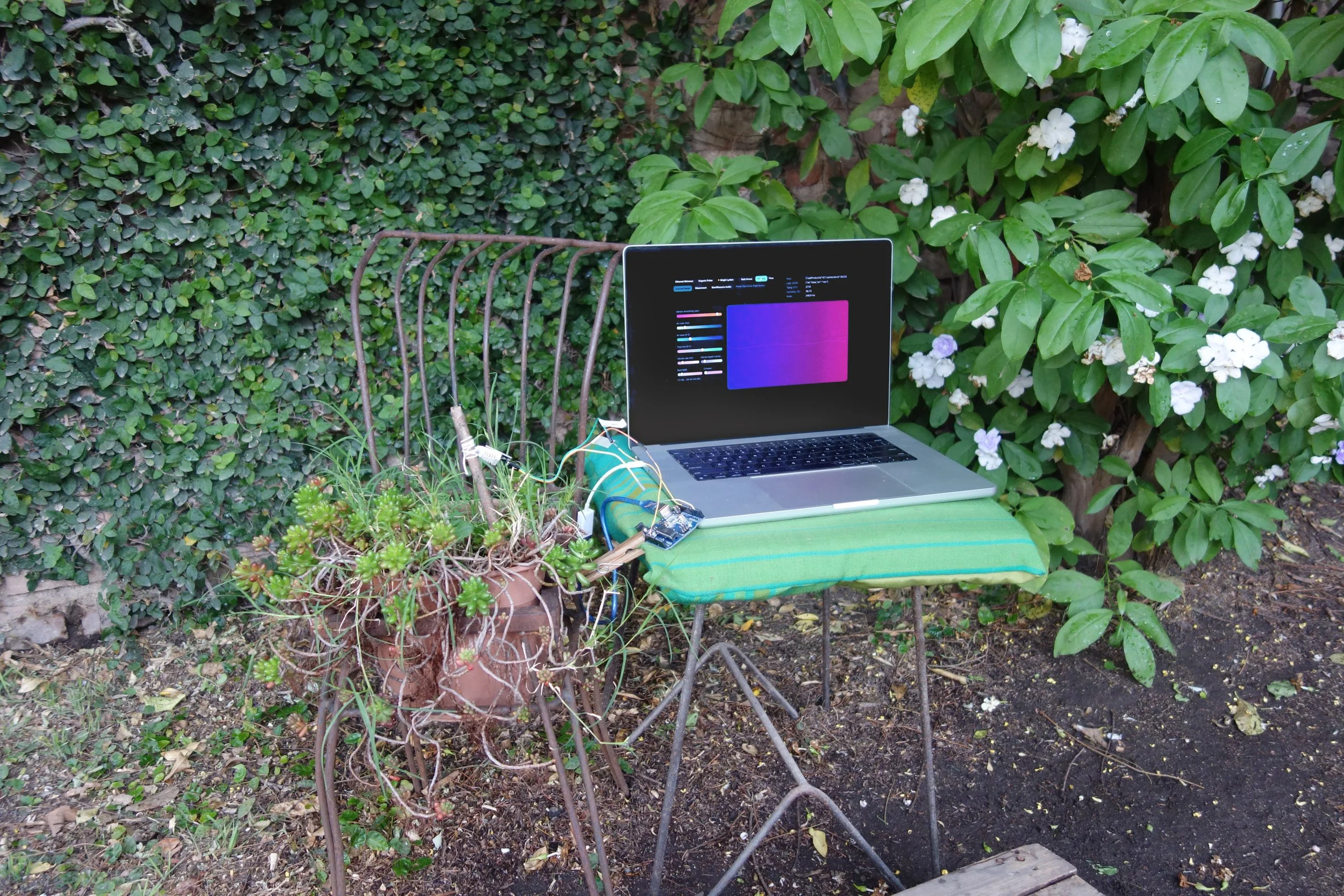
The Humidity Reader (2025)
Medium and materials: humidity and temperature, plant, soil, water, sunlight
Technology: Arduino + DHT22 sensor (humidity and temperature data), OpenFrameworks for real-time sound and visualization
This ongoing experiment translates environmental data from a living plant into generative sound and motion graphics. Variations in light, humidity, and temperature produce shifting tones and rhythms, allowing the environment to “compose” its own score. The work explores how technology can serve as a translator of ecological intelligence, revealing patterns of communication between living systems and digital interpretation.
Through this prototype, I have become increasingly aware of the energetic and material footprint of the tools that make such translation possible. This insight opens a critical inquiry for my next phase of research: how to design low-power, biodegradable, or repairable interfaces that minimize waste while maintaining sensory richness. The project thus becomes both an artwork and a test site for rethinking technology’s role within regenerative ecosystems.
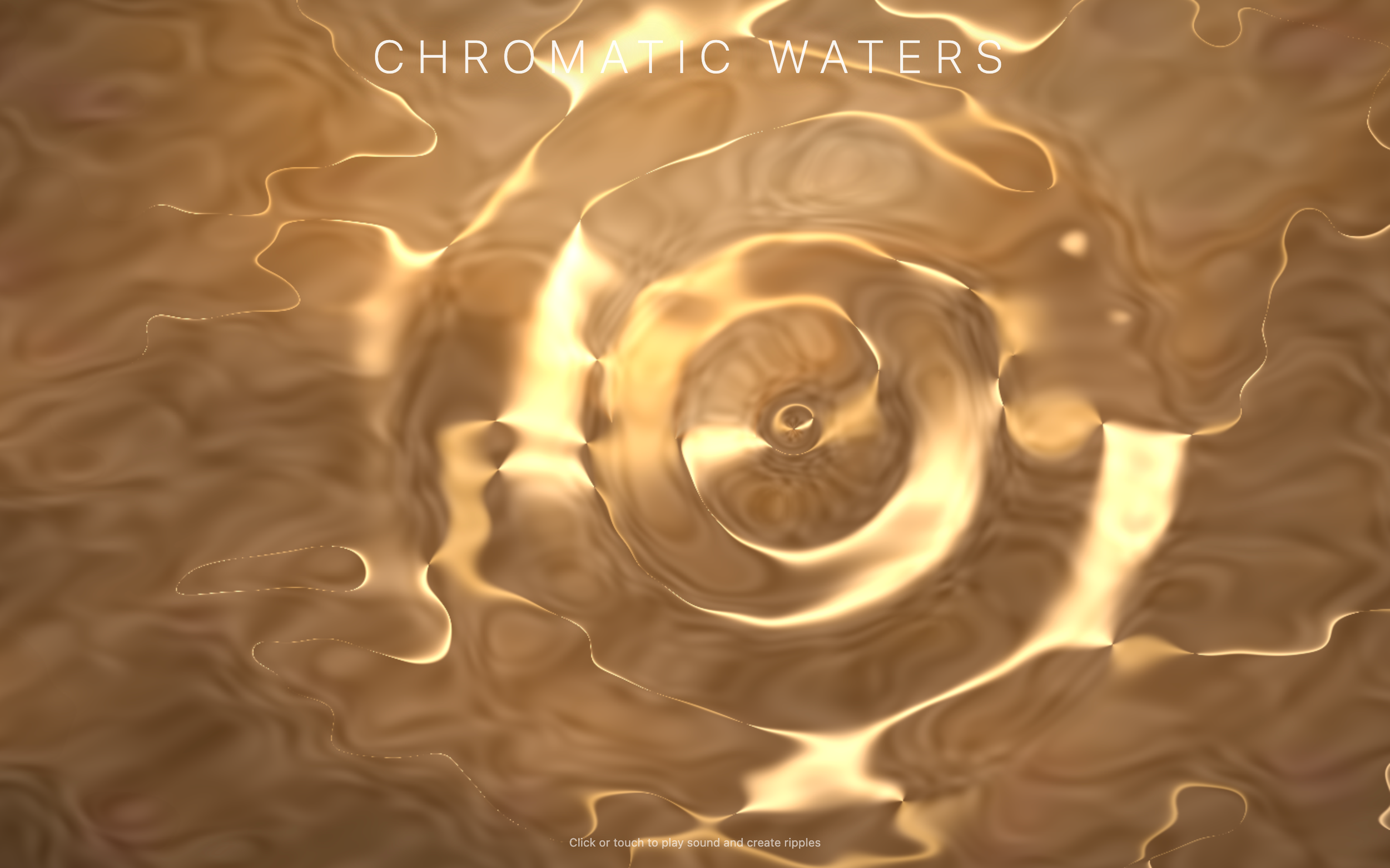
Chromatic waters (2025)
Explore: https://chromatic-waters.vercel.app/
This interactive digital sound piece forms part of a broader investigation into environmental acoustics, sensor-based technologies, and the material poetics of place. Recorded underwater in the Calamuchita and Suquía rivers of Córdoba, Argentina, the work draws from the canto rodado — the resonant friction between rock and current. Through this interplay of softness and solidity, motion and rest, the piece invites a sensory encounter with a landscape in constant change. It is an encounter between hardness and softness, stillness and flow, freedom and weight — a conversation between the river’s body and its moving breath.

The humidity reader
The air speaks — The Humidity Reader listens.
Slightly sweaty, totally fabulous. 100% attitude.
I ❤️ sound art
Medium and materials: humidity and temperature, plant, soil, water, sunlight
Technology: Arduino + DHT22 sensor (humidity and temperature data), OpenFrameworks for real-time sound and visualization
This ongoing experiment translates environmental data from a living plant into generative sound and motion graphics. Variations in light, humidity, and temperature produce shifting tones and rhythms, allowing the environment to “compose” its own score. The work explores how technology can serve as a translator of ecological intelligence, revealing patterns of communication between living systems and digital interpretation.
Through this prototype, I have become increasingly aware of the energetic and material footprint of the tools that make such translation possible. This insight opens a critical inquiry for my next phase of research: how to design low-power, biodegradable, or repairable interfaces that minimize waste while maintaining sensory richness. The project thus becomes both an artwork and a test site for rethinking technology’s role within regenerative ecosystems.

Visits CDMX I — Of Water Resiliency (2024, Ciudad de México, MX)
Visits CDMX I — Of Water Resiliency (2024, Ciudad de México, MX)
Indoor gallery installation view
Materials & Techniques:
Rooftop and indoor gallery intervention – rainwater sculpture using cement, transparent plastic tubing, LED light, and repurposed glass vessels with video projection on a suspended plastic container.
Floating Texts – vegetable paper and graphite infused with glycerin.
Paper Bodies and Found Boxes – handmade recycled paper with fibers from Casa Lu’s garden and the bark of a fallen neighborhood tree; black ink, blue pigment, corn fibers, soil, clay, lime, and natural pigments. Found a wooden box with a metal key.
The installation "Of Water Resiliency" explores water’s circulation as both a material and a metaphor for adaptation. Rainwater collected on-site flows through a sculptural network of tubes and glass vessels, illuminated by soft LED light and accompanied by a video reflecting water’s various states—liquid, vapor, and sediment. It highlights Mexico City’s fragile relationship with its underground rivers and droughts, rooted in ancestral wisdom about our connection to the unknown. Created during a rainy season after a severe water shortage, the work embodies resilience in women, water, and waste. The accompanying video, made after a walk conversation with a fellow artist, deepens these themes of care, interdependence, creativity, and renewal.

Visita CDMXIII
Hand-made paper made with fibers from a garden in CDMX, Casa Lu, black ink and blue pigment, rectangular wood box with metal key, 6.2 x 4 ins.
Papel hecho a mano con fibras del jardín en CDMX, Casa Lu, tinta negra y pigmento azul, caja rectangular de madera con llave de metal, 16 x 10 cm

Visitas CDMXI
Floating text, vegetable paper, 3.15 x 8.7 ins.
Texto flotante, papel vegetal, 8 x 22 cm

Visitas CDMX fluyentes, glifos
Glyph-inspired drawings created with soil and clay, painted double-sided in red and blue pigments on gallery glass walls. These marks represent ideas exchanged during dialogues with invited participants in the Guided Visits creative process.

Visitas CDMX fluyentes (roof rainwater sculpture)
Visits CDMX I — Of Water Resiliency (2024, Ciudad de México, MX)
Outdoor gallery installation view
Materials & Techniques:
Rooftop and indoor gallery intervention – rainwater sculpture using cement, transparent plastic tubing, LED light, and repurposed glass vessels with video projection on a suspended plastic container.
Floating Texts – vegetable paper and graphite infused with glycerin.
Paper Bodies and Found Boxes – handmade recycled paper with fibers from Casa Lu’s garden and the bark of a fallen neighborhood tree; black ink, blue pigment, corn fibers, soil, clay, lime, and natural pigments. Found a wooden box with a metal key.
The installation "Of Water Resiliency" explores water’s circulation as both a material and a metaphor for adaptation. Rainwater collected on-site flows through a sculptural network of tubes and glass vessels, illuminated by soft LED light and accompanied by a video reflecting water’s various states—liquid, vapor, and sediment. It highlights Mexico City’s fragile relationship with its underground rivers and droughts, rooted in ancestral wisdom about our connection to the unknown. Created during a rainy season after a severe water shortage, the work embodies resilience in women, water, and waste. The accompanying video, made after a walk conversation with a fellow artist, deepens these themes of care, interdependence, creativity, and renewal.
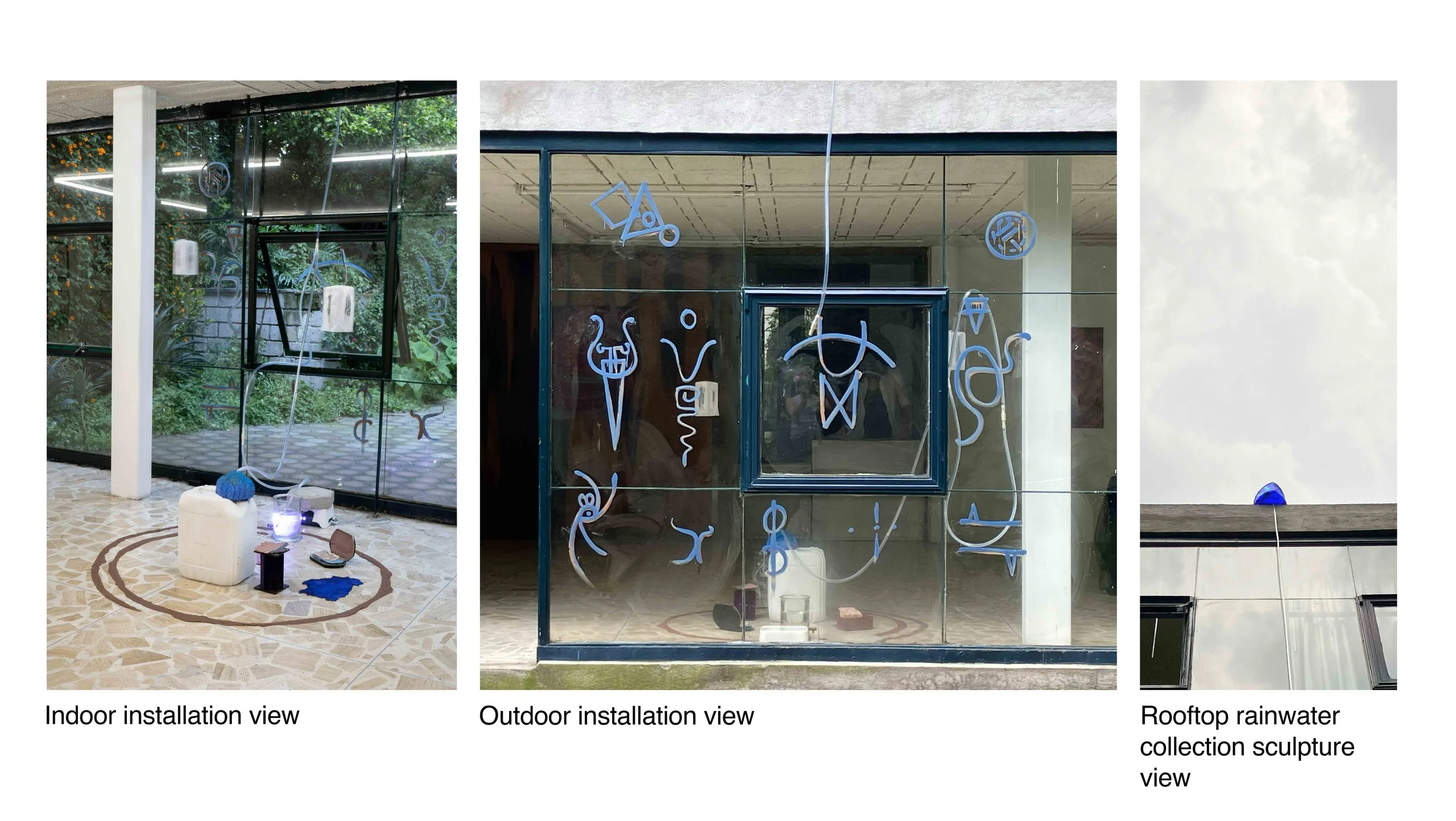
Of water resiliency, visits CDMX Installation (2024, Ciudad de Mexico, MX)
Installation: rooftop rain-water collection sculpture including tubes and LED light, gallery soil and pigment drawings on glass wall and floor, video projector with video and sound piece from the visits project in CDM projected on plastic container and several small pieces: (1) Roaming territories, handmade paper with fibers from Casa Lu Art Residency’s garden and corn fibers, dirt, clay and acrylic paint, 6 x 8.3 ins.
(2) Blueness from the sky to the water, handmade paper with fibers from Casa Lu Art Residency’s garden and blue pigment, 4 x 13 ins. (3) Off to the left, handmade paper with fibers from Casa Lu Art Residency’s garden and corn fibers, dirt, clay and acrylic paint, 11.8 x 18 ins. (4) Vist CDMXII, paper with fibers from Casa Lu Art Residency’s garden vegetable paper, 5 x 7.8 x 1.6 ins. (5) Vist CDMXIII, paper with fibers from Casa Lu Art Residency’s garden, black inc and blue pigment, found wood box with metal key, 6.2 x 4 ins. (6) hanging written lanterns made of vegetable paper, natural glicerine, graphite and india ink.
Creative ecology of imagination